| | Feature
The Jews Called Him King: R' Dovid Oppenheim
by N. Aviam

Part 2
This was originally published in 5636.
For Part I of this series click here.
For Part III of this series click here.
"Everything is dependent on mazal, even the sefer Torah in the heichal," said Chazal. Just as sifrei Torah in the heichal are dependent on destiny, so, sometimes are living sifrei Torah, the talmidei chachomim of each generation. Even one who has labored in Torah and, with siyata deShmaya has grown very great, is still to a degree, dependent on mazal.
So it was with the gaon, R' Dovid Oppenheim, Rav of Nicholsberg and then of Prague and the Bohemia region. This illustrious gaon was one of the greatest gedolim of his time and enjoyed outstanding Torah and wealth. Although he was highly esteemed by his co-generationists, nonetheless, after his death, his name was eventually forgotten. Many bnei yeshivos don't even know that there was such a person.
The first part described what little is known of his youth, and his accomplishments. All the great Torah scholars of his time considered him the foremost scholar of his time. He was rav of Moravia and of Prague, and used his vast wealth to support Torah institutions in those communities. He also was in charge of fundraising for Eretz Yisroel and in gratitude the Jews of Yerushalayim appointed him the rav of Jerusalem.
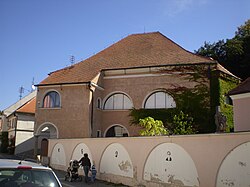
A shul in Nicholsburg
A Libel
In 5472 (1712), the [local] Ashkenazic Rav of Yerushalayim was arrested and thrown in to prison by factors who wished to extort money from the Jews. In order to redeem their rav, the city's poverty stricken Jews who were heavily indebted themselves, borrowed money from a Jew from Damascus named Yaakov Siman-Tov. The agent between the Damascus Jew and the Jews of Yerushalayim was the Sultan's Jewish doctor, Reb Yosef, who promised Yaakov Siman-Tov that the money would be returned to him, with interest.
When the time to repay the debt arrived, R' Yosef, who was in charge of Kupas Yerushalayim, found himself without the necessary funds, and Siman-Tov was sent to Prague, to R' Dovid Oppenheim, who agreed to pay the debt. R' Dovid received him with much honor, and hosted him royally. After three weeks, when the entire chain of events had been clarified, he summoned him, and gave him the amount he deserved.
But Siman-Tov refused to accept the sum, claiming that with the interest, and his fee as an intermediary, he deserved far more. Negotiations between the two led to no compromise regarding the interest and the increments which Siman-Tov demanded.
Angrily, Siman-Tov left Reb Dovid's home. In Prague he found a "friend" from his hometown, a Christian Arab, named Didot, who had been born in Damascus. Didot was well-known to the Jews of Prague as a rather unsavory character. Didot listened to Siman- Tov's claims, and expressed a readiness to come to his aid, successfully persuading him that if he converted to Christianity, it would be easier to act.
Didot, who apparently knew something about law suits, assembled and compiled all of the information which his friend the apostate needed, and presented it to the authorities. In the libel, it was claimed that R' Dovid was considered a king by the Jews, in particular the king of Yerushalayim and Eretz Yisroel — something which was akin to rebellion against the ruling king.
Later on in the writ it was claimed that R' Dovid had helped the Turkish Sultan, the enemy of the Kaiser of Austria, sending him money under the guise of, "Help for the Jews of Yerushalayim." In exchange for this help, it claimed, the Sultan had promised to crown him king of Yerushalayim and Eretz Yisroel.
The trial commenced in 5479 (1719), and R' Dovid and his community were charged with rebellion. An appeal to reverse the verdict was made to the Kaiser of Vienna, but then, too, the informer, with the help of the Jesuits, whose center was Prague, reached the Kaiser.
At the order of the Kaiser, a retrial was held in Prague, with the Jesuits as the prosecutors. Pointing to various books which contained haskomos from R' Dovid, and to various rabbinical manuscripts, they "succeeded" in "proving" that R' Dovid Oppenheim had indeed been crowned "King of the Jews" and Melech haMoshiach [something they derived from the usage of the phrase, "ruach appeinu, melech haMoshiach" which appeared in his writings). The conclusion: R' Dovid Oppenheim aspires to be Melech haMoshiach, and to uproot Christianity from the world, and most important of all, to dethrone the Austrian Kaiser.
R' Dovid and the community of the Jews of Prague managed to convince the governor that these were merely titles of honor, and had absolutely no practical connotations. But only the governor was convinced. The Kaiser, who feared for his throne more than the governor of Prague, decided to proceed cautiously.
In 5493 (1733), he publicized a ban against collecting money for Eretz Yisroel in the lands of Moravia, Bohemia and Shelzia. A third of the amount seized was promised to whoever would bring about such a situation. In addition, an unprecedented ban was placed on R' Dovid, forbidding him to give approbations without the approval of the Jesuits. (This is history's only record of such a ban.)
By the same token the Jews were forbidden to call him Hamelech Dovid, Moshiach Hashem, Ohr Olam, or similar titles. In all of the books and writings in which these titles were mentioned, the Jesuit censor worked overtime to delete them.
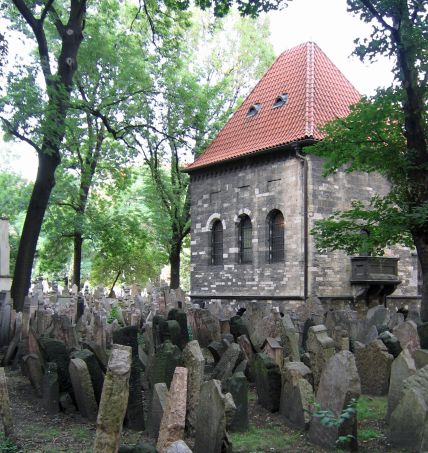
Jewish Cemetery in Prague
The Falsifications of a Historian
The various bans did not diminish the esteem in which the Jews of Europe, and in particular the Jews of Prague, held R' Dovid. This is especially evident from the writings and seforim of his students, and from the inscription on the special tombstone at his grave.
These long and detailed descriptions didn't prevent the historian and maskil, Graetz, from portraying R' Dovid in a totally false and distorted light. Under ordinary conditions, we would not bring such narishkeit, but since this forum provides us with the opportunity to prove the level of the Graetz's knowledge, and his accuracy, we have chosen to take advantage of it.
This is what he said: "At that time, R' Dovid Oppenheim merited fame far more from his huge library, than from his deeds and the books he wrote. He was a kabbalist, who was very engrossed in esoteric studies. But these studies distorted and blunted his mind. He had no time to study Torah, and no time to care for the needs of the community or for those of the Jewish people at large, because he was too involved in his business affairs. Whenever pressing and important questions regarding the community of Prague or klal Yisroel were on the agenda, he could not be found at home, because he was busy pursuing his business affairs, in order to expand his wealth... As far as the affairs of the klal were concerned, he was very negligent."
In the end, Graetz determines that Rav Dovid Oppenheim, as Rav of Prague, was at odds with R' Yonoson Eibeshitz, who was a rosh yeshiva in the city. The main reason for their conflict, he says, was that R' Yonoson had many students, and R' Dovid didn't. He "proves" his point by the fact that R' Dovid did not sign the proclamation against the Sabbateans, because it had been initiated by R' Yonoson.
Not a Word of Truth
One may safely say that Graetz's assessments don't contain an ounce of truth. Everything he says, regarding R' Dovid, is false from beginning to end. Graetz, like many of his students who follow his methods used the approach of: "What I don;t know, or don't understand, simply isn't!"
The determination that R' Dovid had "no time for Torah study," is based on Graetz's unawareness of the existence of R' Dovid's shutim. Graetz "knows" that Reb Dovid was "more famous for his library than for his deeds and the books he wrote," while one who examines the many questions which were sent to R' Dovid, and the writings of his students and the geonim of his times, as well as the various letters sent to him, will find barely find a reference to the library. All of them express their great esteem of him as a godol beYisroel, with the most superlative terms.
Graetz's premise that Rav Dovid dealt primarily with the assets of his uncle, and that the main center of his business affairs was Vienna, is completely disproved. His biographer, Yaakov Koppel Dushinsky pointed that out, and as proof brings the fact that the royal documents which contain business records of great merchants such as R' Shlomo Oppenheim and R' Shlomo Wertheimer, the mechuton of R' Dovid Oppenheim, there is not one document attesting to a business dealing contracted by R' Dovid Oppenheim. The only pertinent document which appears there, under his name, does not concern his business dealings but rather the taxes imposed on the Jews of Bohemia, which the R' Dovid took care of. But Graetz already determined: "He had no time for the affairs of his community or of klal Yisroel.'
It is interesting to read between the lines, and to see whether Graetz's claims have any validity. R' Dovid writes: "I am very inundated with work — good work — the work of the students who listen to my voice, and the work of responding to questions. ...Every day, new milei deShmaya are mischadesh, and I am very overburdened."
In a response to the kehilla of Brisk, he writes: "I have been overwhelmed by many burdens, and by the details of certain very deep shailos... as well as by the people who stand before me from morning until night."
In another response, (Chol Hamoed, stanza 1): "And the entire Nation stands before me from morning until night, so that I can barely even [catch my breath]. I am especially burdened by the affairs of the community and the country."
In yet another place he writes, "Kevod Toraso already knows about the tremendous burdens which rest on my shoulders, beginning with those of the remarkable yeshiva, which we maintain from chaztos halailA to chatzos hayom. And in Chol Hamoed stanza 11, he writes "Despite the many difficulties, (and he enumerates them), nonetheless, I didn't take time from Torah study, and the beis medrash, and I guided my tzon kedoshim, my precious talmidim, pausing from all my endeavors in order to respond to those with questions."
This picture emerges from scores of his responses. But who can argue with the historian? Scores of seforim, written by his many students in the various communities in which he officiated, tell about the about the yeshiva and the community. Some of these books were seforim printed while he was still alive (and surely during the life of Graetz).
His supposed contention with R' Yonoson Eibeshitz is also a fabrication. Testimony to this are the words of R' Yonoson in a letter of apology regarding the printing of the Shas in Prague. In this letter, which wasn't publicized during his life, R' Yonoson accords R' Dovid much respect and testifies that nothing was done without asking the Rav HaGaon, the av beis din.
Why didn't R' Dovid sign the declaration against the Sabbateans? (Today, every declaration is checked over and over again to see who didn't sign, and who as well as who did.) The reason is unknown to us; but perhaps Reb Dovid wasn't in the city at the time of its appearance. Graetz's comment that "most of the time" R' Dovid was away from his community, then, contradict this "proof" of the imaginary conflict.
The only reason we have spent time rejecting Graetz's ridiculous statements, is to demonstrate the level of the reliability of various historians and experts. Since all of Graetz's descriptions are absolutely untrue, from beginning to end, we can imagine the extent of the inaccuracies of his other writings. Let the details teach about the totality, in this case.
What is interesting is that Graetz's history books are regarded as absolute truth by later historians, and as a result of this even the Jewish Encyclopedia contains many gross errors.
In 5497 (1737), at the age of seventy-three, he returned his pure soul to his Maker. All Jewry was plunged into a deep state of bereavement. But the greatest brunt of the calamity was felt by the community of Prague, whose Jews felt that no one could fill his shoes and be a rosh yeshiva, a parness, a rav a naggid and a shtadlan all at the very same time.
The Jews of Prague erected a tombstone over his grave. The inscription they composed praises him with hundreds of words, and is so crowded that not even one more word can be added.
We will cite two of those stanzas here, in order to prove once more that Graetz was a giant fabricator:
"Thoroughly well versed in all parts and recesses of the Torah, he never ceased from his studies, ...he maintained yeshivos and baalei Torah and strengthened Torah. Flocks streamed to him. He produced many students, and there is no limit to his chidushim and drushim on the entire Torah.
"His hand was open, and he gave a fifth of his earnings to charity. He once gave more then fifty thousand reichs-thaler as part of ma'aser money. He was rosh lechol davar shebekedusha, and the first to participate in any mitzvah. The greatest of the chabura degemillus chassodim, chabura kadisha, it may be said of him, "When Rabi died, kedusha was nullified."
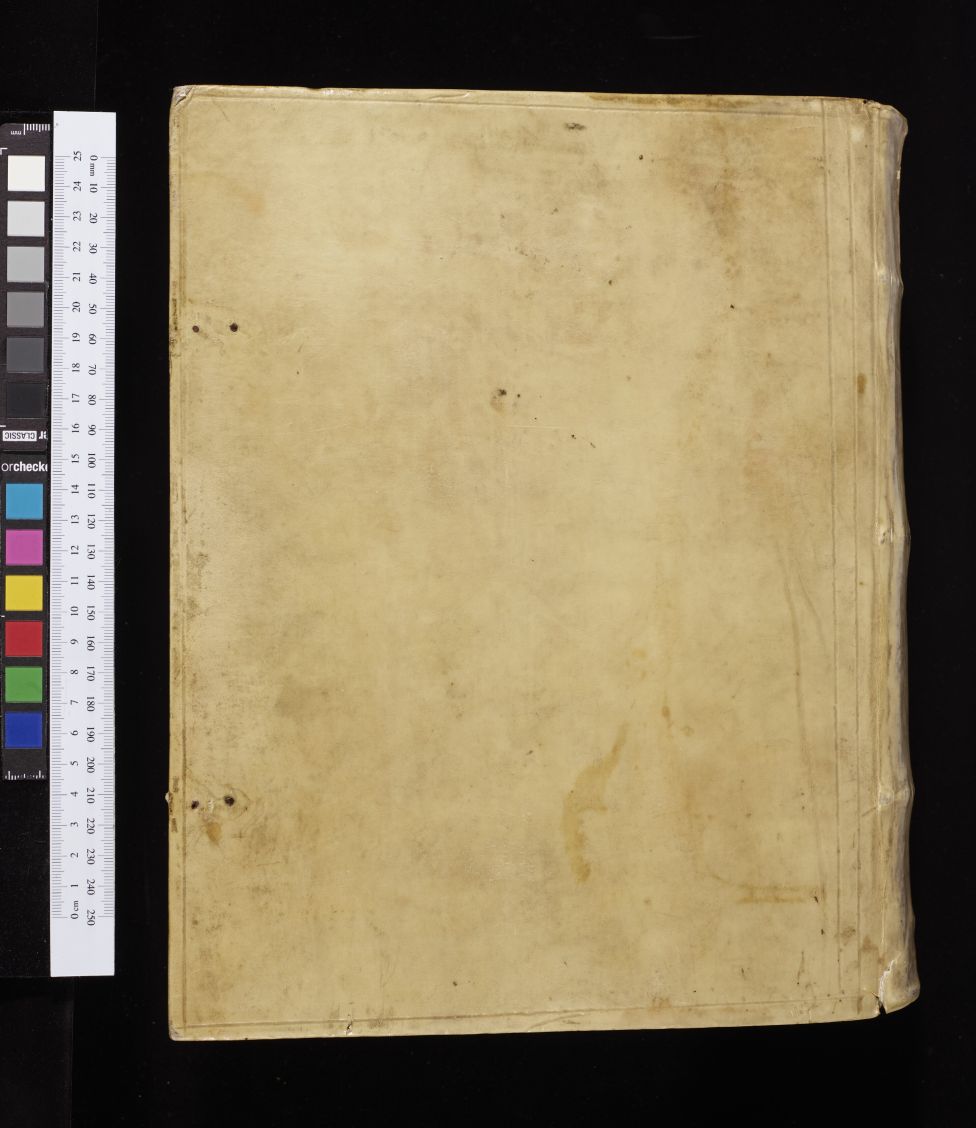
Medrash Tanchuma from the Oppenheim Collection at Oxford
The Manuscripts Were Redeemed on a Wheelchair
A library during those days was a rarity. The library of R' Dovid Oppenheim was even more rare, not only for the books which he printed, and in which he invested all of his time and energy, but also for those which still hadn't been published. Some of them were printed, especially for him, on parchment. When the decree to burn all Jewish books in Prague was issued, the library was "out of town." Many, including gentiles, tried to acquire the library. In the end, it reached the Bodlean Library in Oxford. The hypocritical maskilim were aghast. This is the story of the rare treasure and the miracle by which it was saved.
R' Dovid Oppenheim was unique in many ways. Some of them were described in our previous article. This article is devoted to yet another aspect of his life: his famous library.
Today, even young children understand the value of an accessible library. Every Torah scholar purchases many useful seforim which he pores over in his own home. Public institutions maintain libraries with thousands of volumes, which anyone who wishes may read. In addition they employ, at full cost, various experts who understand the nature and the value of these treasures.
In generations past, the situation was quite different. Not every town merited even a complete Shas. The simple Jew owned siddurim, chumashim, mishnayos and a few tractates of the Gemara. Wealthy people owned additional seforim, and only important rabbonim made the effort to purchase the seforim they needed in order to answer the many sheilos addressed to them.
Obviously, a large private library aroused much amazement, and surely one as vast (in the concepts of those days) as that of R' Dovid Oppenheim was a source of awe.
Toward the end of his life, this collection contained about seven thousand printed volumes, and nearly one thousand manuscripts. In order to fathom the vastness of such a quantity according to the concepts of those times, it is enough to glance at the seforim shrank of the average ben Torah. Such a private library generally contains about five hundred books, and not always. Most of them were published over the past two hundred and fifty years. (Some of the rishonim which we have today, were not in printed form two hundred years ago, such as the Beis HaBechira of the Meiri.)
End of Part 2
|